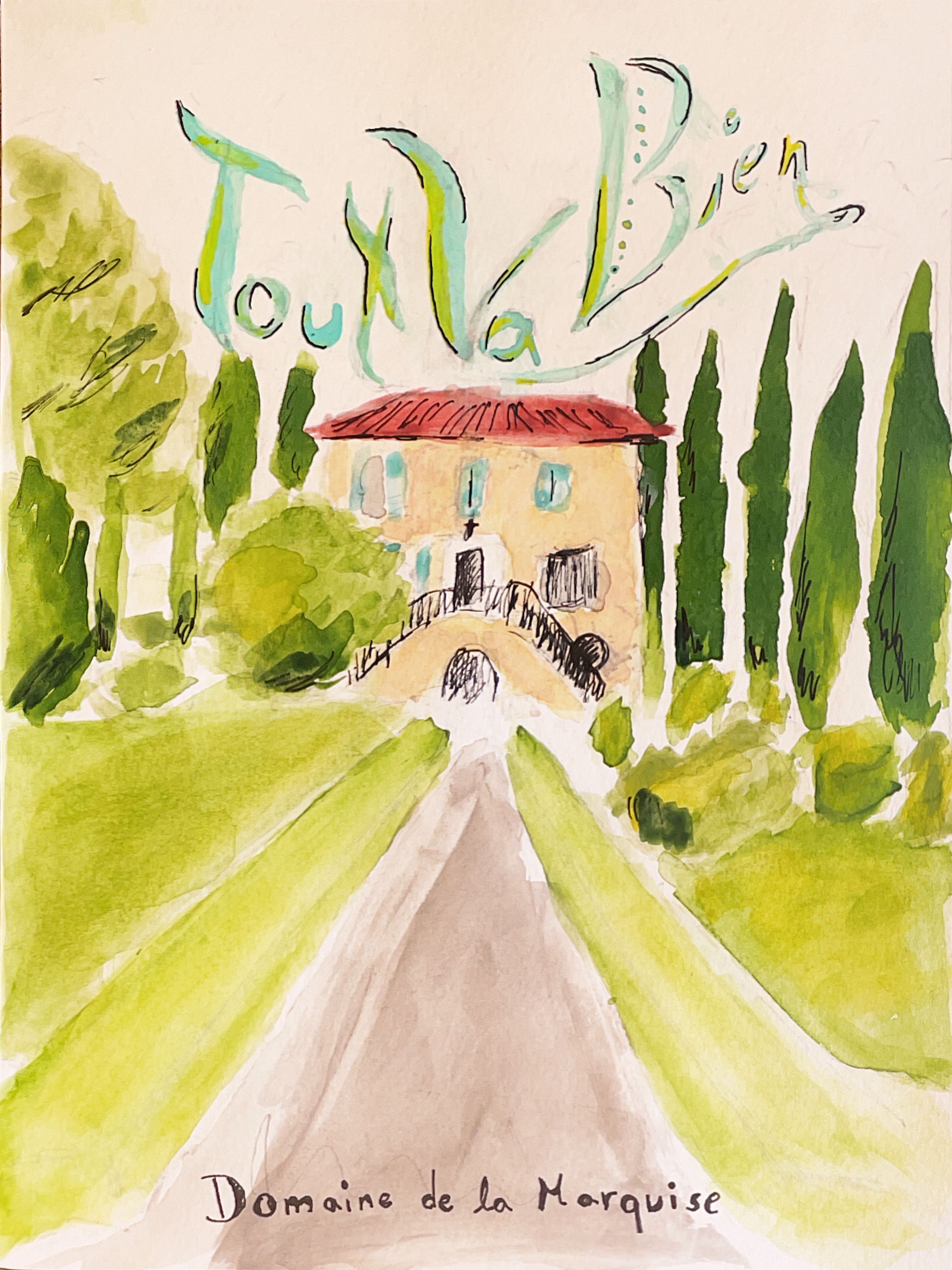
The History of Domaine de la Rose Comtesse Is a Love Story
Our purchase of the Domaine de La Rose Comtesse is a love story. It all started in 2022, on a terrible windy day with a foul storm brewing. Nothing could hide the beauty of the pink house, though, glistening in the rain. She glowed from within. It was a coup de foudre.
The neighbors had long called the house the Secret Bastide. Some said that the home was previously owned by a crotchety countess, others pointed out that at some point the bastide was attached to all the surrounding farmlands. Evidence to support that point is visible in the now converted stables at the edge of the domain, where you can find an old cantine for the paysans inside, complete with a—still intact—18th century sink.
The house was most probably an olive oil producing estate with perhaps grain cultivation. Ventabren in the 1700s was known for these products, supporting the region’s Savon de Marseille production and also providing olive oil for cooking and consumption. The three-story home was most likely built between 1760 and 1790, an era when the houses were built with a classical five-bay arrangement: two windows, followed by a central door and then additional windows. This symmetry is a hallmark of late 18th-century Provençal bastides built by prosperous agricultural families or Aix bourgeoisie. The central arch under the terrace allowed for storage (perhaps olive oil) below and the symmetrical staircases leading to the elevated main floor (étage noble) created a dramatic way to enter the main reception room, which is punctuated by its high ceilings—another mark of social structure.
According to the property deeds, the Provençal agricultural family of Terazza (Maurice Jean Terraz (or Terrazza/Terraz) and his family most likely built the bastide in the 1700s. After approximately 200 years, the property appears to have been sold to Marie Albert Gaston Swaton and Marie-Antoinette Rosnoblet. The Swaton family seemed to be a prosperous line from further north in France, while the Rosnoblet family name is associated with the Haute-Savoie region and the Savoyard bourgeois families. It was common even then for wealthy Marseille families and families from farther north to purchase a summer home. And Ventabren was an easy 1-day carriage drive into the town of Aix en Provence.
From there the home was sold to Marseille residents, the Dessieux and Valerio family, who sold the property in 1949 for 2 million francs ($77,000 today). At this point homes in Southern France post WWII were relatively inexpensive, but that price was equivalent to 20 years of an average worker’s salary and indicates that it was most likely still 20 plus acres and included agricultural land. More research will need to be done to find out when various chunks of the estate were carved away.
Mid-century, a woman named Julia Léocadie Joséphine Aras (later Mme. Chaineux) gained full ownership after she legally separated from Roger Octave Marie Ernest Chaineux. Chaineux, a Belgian aristocrat and landowner, is most likely the source of the countess rumors. According to one of the repairmen who visited the house when she was a resident, she was “very mean and very religious.” Next, the home was sold to another Marseillaise family and now to the current owners.
They began a major renovation of the home in 2022 after acquiring the property. Working with diligence for more than two years, the goal was to retain the beauty and character of the home while updating it for the future and making it more comfortable for modern living.
"After living in several different bastides in the Aix-en-Provence region," they said, "We understood how differently we all live today. For example, kitchens are no longer places for servants, dark and windowless. Homes need to function in the modern world but also retain the beauty and old-world quality that makes living in France so very special."
The couple navigated the inherent tension between how much to change and how much to retain. And the result is a home that bridges both worlds. A converted greenhouse serves as a summer kitchen and hangout space. Two of the upstairs bedrooms now have en-suite bathrooms for privacy and comfort. There is adequate storage and power throughout, and enough air conditioning to soften the lazy hot days. The dreamy, maintained garden is private and magical, filled with nooks and crannies for children to play in and to find a quiet corner where you can read a book on a breezy day.
We hope you enjoy our special place.